

Mendala PolyTrauma Clinic · Resident Research Award
Mendala Brain Injury Research Scholar Program
The Mendala Brain Injury Research Scholar Program is an annual research award for residents of the Texas Institute for Graduate Medical Education and Research (TIGMER). Scholars conduct mentored research in traumatic brain injury at Mendala PolyTrauma Clinic for one academic year.
| Award | Up to $2,000 per scholar in research funding |
|---|---|
| Number of awards | Two per academic year |
| Term | One academic year, July 1 through June 30 |
| Eligibility | TIGMER residents who will be PGY-3 or PGY-4 during the term |
| Application period | March 15 through April 15 |
| Announcement | June 15 |
| Faculty mentor | Safa Rubaye, MD |
Purpose
Mendala PolyTrauma Clinic treats patients recovering from traumatic brain injury (TBI), with a focus on psychiatry and neurology. The program supports the development of resident investigators in brain injury medicine.
Each scholar designs or joins a study, carries it through analysis, and submits the work to a scientific meeting or a peer-reviewed journal.
Award
- Research funding of up to $2,000 for costs associated with the scholar's research, including travel, conference registration, and printing.
- Faculty mentorship, access to clinic data under approved protocols, and research staff support.
- Authorship on all work to which the scholar contributes, in accordance with ICMJE criteria.
- The title Mendala Brain Injury Research Scholar for the award year.
Eligibility
- Applicants must be TIGMER residents in good standing.
- Scholars must be in their PGY-3 or PGY-4 year during the term. Residents apply in the spring of their PGY-2 or PGY-3 year.
- The Program Director must confirm that the resident is available to participate.
Research scope
Any research question related to traumatic brain injury is eligible. The areas below describe the clinic's current and developing interests and do not limit the scope.
- Advancement in therapeutics. New, optimized, and repurposed treatments for symptoms after TBI, such as ketamine therapy and transcranial magnetic stimulation for mood, cognitive decline, or tinnitus.
- Innovation and technology. Digital, device-based, and home-based tools that extend care beyond the clinic, such as virtual reality in the clinic and at home.
- Biomarkers and diagnostics. Objective measures that support diagnosis, track recovery, or predict response, including imaging, neurophysiology, and cognitive testing.
- Clinical outcomes and recovery. Changes in symptoms, cognition, and function over time and with treatment.
Scholars may join a study already under way or propose an original project. New projects require IRB review before they begin.
Scholar responsibilities
- Conduct a defined research project at the clinic under the faculty mentor's supervision.
- Follow a schedule arranged with the residency program. Required rotations, didactics, and duty-hour limits take priority.
- Complete human-subjects training and comply with IRB, HIPAA, and clinic policies.
- Submit the work as an abstract or presentation to a regional or national meeting, or as a manuscript to a peer-reviewed journal.
- Present the work at a TIGMER research day or equivalent forum.
Selection
Applications are reviewed by the clinic, and finalists are interviewed. Selection is based on:
- The clarity and merit of the applicant's research interest.
- Its relevance to traumatic brain injury.
- The feasibility of the work within the term.
- The applicant's academic and professional standing.
Application
Applications are accepted by email from March 15 through April 15. Submit the following to rubaye@mendala.health and ashah@mendala.health:
- A current curriculum vitae.
- A statement of research interest of no more than one page, describing the question or area the applicant wishes to pursue and the intended outcome.
Timeline
| March 15 | Application period opens |
|---|---|
| April 15 | Application deadline |
| April to June | Review and interviews |
| June 15 | Scholars announced |
| July 1 | Term begins |
| June 30 | Term ends |
Terms of the award
- Funds are paid as reimbursement for approved research expenses on submission of receipts.
- Expenses for presenting or publishing work completed during the term may be reimbursed after the term ends.
- The award is not salary or a stipend and does not affect resident compensation.
- A scholar whose project shows strong results may apply for a second year.
Contact
Safa Rubaye, MD: rubaye@mendala.health
Aditya Shah, DO: ashah@mendala.health
Mendala PolyTrauma Clinic, 7800 I-10, Suite 624, San Antonio, TX 78230
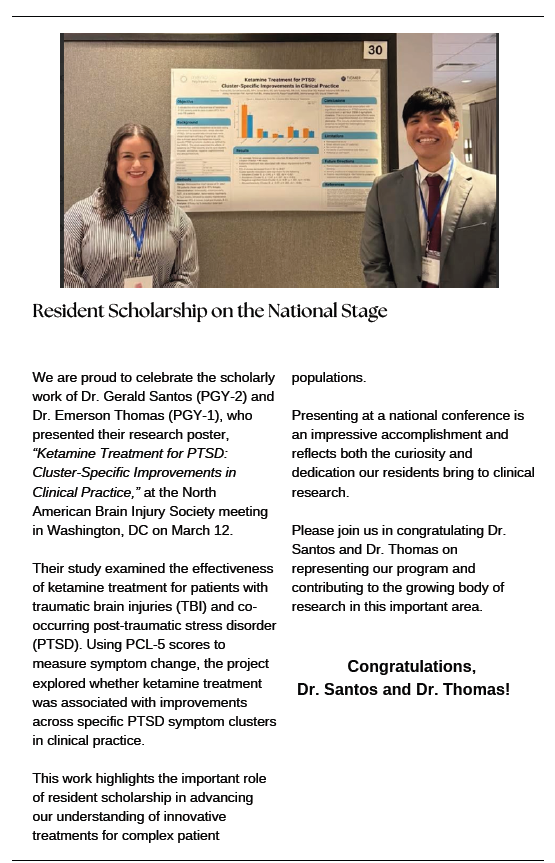
Poster Presentation
In collaboration with TIGMER, Mendala PolyTrauma Clinic presented “Ketamine Treatment for PTSD: Cluster-Specific Improvements in Clinical Practice” at the North American Brain Injury Society meeting in Washington DC on March 12, 2026.